Apple Butter: My Family’s Beloved Historic Tradition
I can speak with some authority on the subject of apple butter. I am part of the 5th generation (at minimum) in my family to carry on making the stuff the old fashioned way. My grandfather recorded memories of making apple butter with his grandmother in the 1930’s, and making apple butter the same way our ancestors have made it in centuries past is a prized part of my family’s culture. To me, apple butter is made gallons at a time in a copper kettle (a 2 ft or larger diameter pot) over an open fire using a 19th century style method which was conveyed by word of mouth until it was recorded on paper by my late grandmother in the 1990s.
Knowing my family’s handed-down recipe, I wondered, what is the wider history of this delicious stuff. How old is it? What are the essential elements that make apple butter what it is? How can we spread the love of apple butter to those who have yet to learn of its delights?
Late 19th century mechanical apple peeler. Copper kettle filled with apple slices, stirred with a paddle.Jar of apple butter, made in 2023.
“The mere name of ‘apple butter’ brings memories of that spicy, toothsome dainty which is old fashioned but which never goes out of fashion. As it holds the concentrated flavor of the apple, many people think it has no equal as a spread for bread or for serving with meats.”
Evening Star (Washington, D.C. newspaper) September 19, 1919
Many Americans are familiar with apple butter, and know it as the dark brown, sweet stuff that comes in mason jars. In its modern form, it is made from apples, sugar, cinnamon, and sometimes other spices. Unlike other jarred fruit preserves which can be lumpy and difficult to spread evenly onto a slice of bread, apple butter should slide under your knife like, well.. butter.
Heinz Brand Apple Butter newspaper advertisement, 1921
Apple butter often evokes nostalgia.
You may associate this wonderful stuff with Autumn, when apples are ripe. It might make you think of the Amish, a cohesive population of Americans who have famously carried on the tradition of making and selling old fashioned products. It’s not just an Amish specialty, though. Many Americans make a version of apple butter in the Fall, most of them use a pot on their kitchen stove. But, no matter where you get it, tasting the warm cinnamony-apple goodness contained in a jar is like uncorking memories of crisp Fall temperatures and time gathered with loved ones. Even large manufacturers of apple butter have capitalized the well-trod, but effective, trend of evoking positive images of bygone eras to court customers. Fortunately, it only takes simple ingredients and time to make it (and the memories to go with it) yourself.
The Substance: What is Apple Butter?
It’s sometimes styled as one word: “applebutter,” but no matter how you spell it, apple butter is a fruit spread made from apples and spice. In culinary terms, apple butter is a reduction. This means apples are cooked down to reduce the water content. Spices are added for additional flavor.
Despite what someone unfamiliar with this culinary delight might guess, there’s no dairy in apple butter. However, when made properly, this historic foodstuff has a smooth, spreadable consistency similar to that of soft butter. While the best known type of fruit butter is probably “apple,” it is not the only one. In cookbooks, recipes for apple butter are often grouped with peach butter, pear butter, plum butter, grape butter, and more.
The Purpose of Apple Butter
Why was it made?
Historically, preserves of all forms added much needed nutrition and variety to meals during winter months. Like many foods that predate refrigeration (such as spirits, ham, pickles, and cheese), making apple butter was at its core (pun intended) a way to transform a fresh food into a product that could be shelved and would be safe to eat months into the future. Eating the fruit fresh off the tree was a seasonal treat, but for families living on homesteads who cultivated apple trees, there were often too many apples to consume them all one fresh bite at a time. Among the many practical uses for apples were making cider, vinegar, feeding to livestock, and making apple butter.
Workers at apple packing house, Camden Co, New Jersey, 1938 (public domain via NYPL)
(We will come to a deeper look at apple butter’s history in Apple Butter, Part II. For now, let’s continue to discuss what goes into making it.)
The Ingredients: Apples, Spices, Sociability, and Effort = Apple Butter
Apples
It probably doesn’t need to be said, but I’ll say it anyway. You need apples to make apple butter, lots of them.
Apple trees were a common fixture of American homesteads wherever the climate allowed them to be cultivated. Rural communities used the apples that were cheap, available, partially bruised, or otherwise imperfect to make cider and apple butter. The apples don’t have to be pretty.
Still Life with Apples, Charles Ethan Porter, 1886 (via NGA)
But, what kind of apples?
J. George Frederick recalled, in his Pennsylvania Dutch Cook Book published in 1935, that in addition to Maiden Blush and Smokehouse apples, “Rambo, Bellflower, York Imperial and Vandevere, Mama Beam, Fanny, Winter Banana, Hiester, Susan’s Spice, Evening Party, Blue Mountain, Fallowater, Smith Cider, etc,” were all suitable varieties for making apple butter. Good luck finding any of those today.
Generally speaking, you should seek out a sweet, slightly tart apple that you can buy by the bushel (A bushel is a unit of volume which is roughly the same size as a cardboard bankers box).
My family has always sought out Jonathan apples for making apple butter, which is an heirloom variety that originated in the early 19th century and can still sometimes be found today. Jonathans are small, have a sweet and slightly tart flavor, tough skin, and most importantly, turn to very smooth mush when cooked. The newer Jonagold apples can be obtained more easily now than Jonathans and those would work well for apple butter.
Winesap or Rome apples, like Jonathans, are also very old varieties that retain their flavor when cooked, and each would make an excellent traditional choice for apple butter. While Winesap, Rome, and Jonathan are perfect heirloom varieties to use if you can get them, any cooking apple (rather than a table apple) that is readily available inexpensively is worth a try. The object of apple butter, after all, is to make something amazing out of what you have cheaply and abundantly available.
Jonathan AppleRome Beauty AppleWinesap AppleAmerican woman paring apples, circa 1870
Preparing the apples.
The apples have to be peeled, cored, and sliced. All of them. If you have hundreds of apples, this can take hours. Tools like mechanical peelers and lots of sets of hands helps. Good conversation definitely helps too. The heavy, cast-iron peelers driven by hand crank have always served my family well, and if well-maintained, old peelers often work better than apple paring devices that are available in stores today.
Classically, the apples are prepared the night before you plan to cook them, and they can be stored heaped up in a great big pile in a large tub lined with a clean cotton sheet. The apples will brown slightly overnight at room temperature and boil into apple butter just fine the next day.
Spices
The only mandatory spice is cinnamon, although other spices are common additions.
My family’s recipe calls for only intensely spicy cinnamon oil (oil of cinnamon) as flavoring. One or two tiny bottles are enough for a batch made from 2 and half bushels of apples. Most apple butter makers choose to add additional “warm” spices imported from far flung tropical places. This can include allspice, cloves, and/or nutmeg. It is also pretty common to find recipes that also include some amount of vinegar.
Spices (and vinegar, if desired) are usually added at the very end of the cooking process, but can be added in different ways. Some add ground (powdered) spices, while others may soak whole spices contained in a fabric (cotton) bag in the pot to impart the characteristic flavors.
Sociability & Effort
Making apple butter is a project best tackled together.
Although it is possible to make small batches in a kitchen by yourself, that misses a large part of the fun. In the 19th century, many communities looked forward to the “Apple Butter Frolic” with great anticipation. As the apples ripened in the early Fall and the weather began to cool, it was time for making cider and apple butter.
Paring, coring, and slicing great quantities of apples takes hours of work, and in the morning, when you’re ready to cook, the pot must be stirred constantly all day to prevent the sugars from burning. If you’re using a wood fire, that must be tended too. The great copper kettle is stirred with a L-shaped long-handled tool called a “paddle.” This long paddle keeps your legs well clear of the fire and with your gentle rocking motion to and fro, continuously scrapes the cooking mush from the bottom of the pot.
Making apple butter is the perfect occasion for catching up with good conversation while you work and trade off stirring and fire tending duties. When the day is done, everyone gets a taste of warm fruit spread as they help put up the rest of it into the jars that will sit on cellar shelves.
The Process: How is apple butter made?
Like many heritage foods, the process of making apple butter has been modernized over the years, but the old fashioned ways still survive.
While the specifics of any given recipe vary, apple butter requires 4 essential steps.
Peel, core, and slice many (dozens to hundreds) of apples.
In boiling liquid (usually apple juice), cook down the apples slowly, stirring constantly, until thick.
Add cinnamon, and often other spices.
Preserve the resulting product for later use.
Adding sugar. Apple butter originates long before modern pasteurization and pressure canning methods existed, and so depends on the chemical properties afforded by a high concentration of sugar for its long shelf life. The oldest recipes for apple butter call for unfermented “fresh cider” (today we call this apple juice), as the base liquid to which apple chunks are initially added for cooking. In this way, the sugar from juice raises the sugar content of the resulting apple butter and makes it fit for long term storage. Granulated sugar can be added late in the process to achieve this same end. Regardless, caramelization (gentle browning) of the sugars helps to give apple butter its unmistakable, distinctive, and candy-like taste.
Old Fashioned Apple Butter – Communities Have Kept the Tradition Going
Simply put, to make apple butter as it has historically been done, one must organize a work-party. An extended household or small local community comes together to make a huge batch of the stuff while having a good time accomplishing the task together.
Most of us no longer need to turn orchard produce into auxiliary foodstuffs in order to stock pantries for survival through the winter, so the utilitarian reasoning for making apple butter has fallen away. What keeps this process alive in some communities instead? The fun, fall festival type atmosphere of apple butter making builds social bonds, and when combined with the true deliciousness of the product that results, families have found it more than worthwhile to carry forward the tradition as an end in itself.
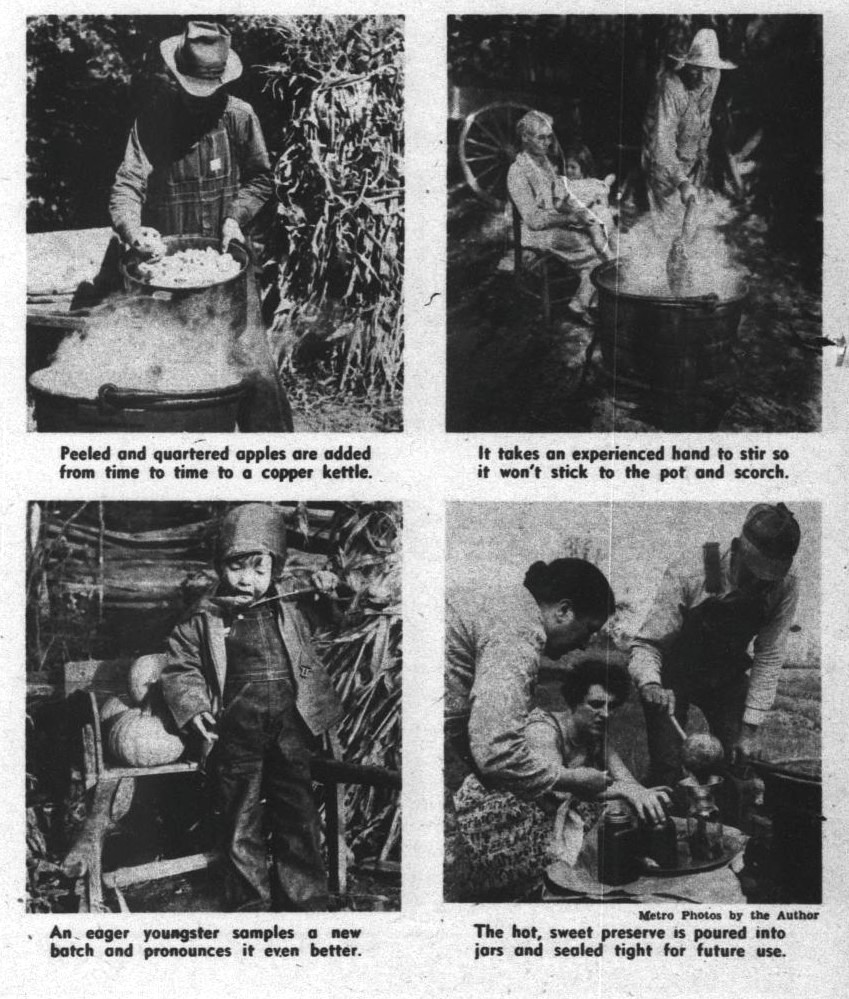
The following article published in a Washington D.C. newspaper in 1956 helps to explain. More detailed explanations of the nuances of old-style apple butter exist, but this piece of reporting highlights the enduring appeal of this tradition and the reasons why every batch is unique.
Apple Butter Day
By EARL PALMER, The Sunday Star Magazine, Nov 4, 1956 (Washington, D.C.)
DOWN in VIRGINIA, folks who’ve sampled all sorts of jellies and jams generally agree there’s one toothsome sweet that beats all. That’s apple butter, the kind the folks over on Laurel Pork Creek, In the Blue Ridge Mountain country, make– outdoors in ages-old copper kettles set to boiling over a wood fire.
Now, over at Albert Hylton’s place, they go in for apple butter makin’s on a grand scale. Long before sunup the women folk are getting things ready; pies and cakes, chickens and hams are fixed for the neighbors sure to arrive later. Right after the apples are picked, bushel after bushel are peeled and set a-boiling while other bushels wait their turn. A fiddle or banjo player comes down the road, and when the music starts the peelin’s fly. Giggly girls and apple-cheeked boys “join hands and circle right’’ around the kettles. There’s work done, to be sure, but it’*a day of festive fun!
The serious business of stirring takes an experienced hand like Pa Hylton, for even a slight delay will cause apple butter to stick to the bottom of the kettle and scorch, thus ruining the entire batch. Three hours before a batch is done, sugar is added—how much depending on individual preference. Some want their apple butter “preservy-like,” others prefer more fruit taste and thus add less sugar. Perhaps the best rule-of thumb measurement, and a popular recipe, says, “Add 2 1/2 pounds sugar for each gallon of apple butter expected.”
It takes a full day to boil down a batch of apple butter. Along about dark of an October day, the kettleful is done—all except addition of spices, salt and vinegar. Here again, opinion varies, and there are many schools of thought on what to add, and how much. Cinnamon is a must. Usual practice is to add half an ounce to a 20-gallon kettle, though some add as much as a full ounce of pure oil of cinnamon and a pound of cinnamon-drop candy for added flavor and color, depends on how “cinnamony” you like your apple butter! Some makers of apple butter add vinegar in varying amounts, claiming that its addition “flashes off” the sweet taste and prevents molding when the product is canned. Many add half a cup of salt to a 20-gallon kettleful; others add just a pinch or none at all.
The kids will eat it any way it comes out, and Ma Hylton sometimes has to shoo ’em away to be sure there’s enough left to put up in Jars for the year.
More apple butter to come.
In Part II, we’ll explore the origins of apple butter and how it’s evolved over centuries. We’ll also list the pros and cons of the various ways apple butter might make its way onto your nearest slice of bread. And, we’ll try to wrap up this journey with my thoughts about the longevity and future of this food tradition.
Join me as we have another “Apple Butter Frolic” soon.


Leave a Reply