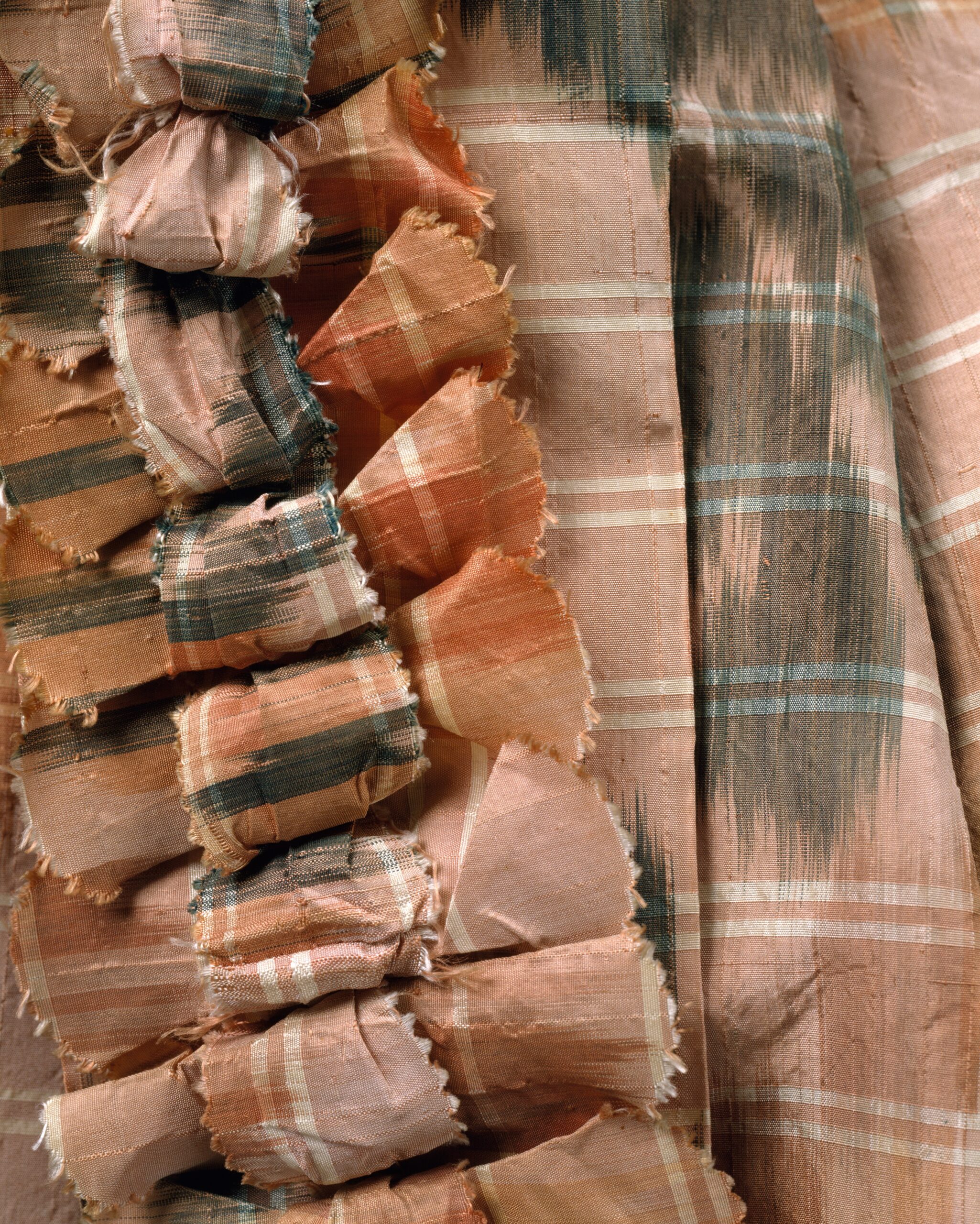
An examination of pinking irons shows us how swings of a mallet can turn strips of cloth into beautiful adornments.
Clothing is important to all of us.
We all are keenly aware that apparel is not merely functional (protects our body), but serves as a vehicle for communicating with the world around us.
What does your clothing say about your social class? What does it say about your awareness of style trends? What “words” does it use to communicate the message?
Perhaps it’s the way the garment is cut, how it hangs on your frame. The condition of the fabric, whether shabby or pristine, can make an impression. Do your clothes create a silhouette that is also favored by influential people? Does it let you blend seamlessly in with the crowd? Can the item be washed over and over and remain in good shape, or does it require costly care and maintenance? How rare and laborious to make are the materials and embellishments?
You know who doesn’t care about what their clothes say?

Computers. Computers don’t care because they don’t have feelings, and they don’t wear clothes. Unfortunately, the state of the internet has made it so that it’s necessary for me to state that this content was not generated using artificial intelligence (AI, large language models). This blog continues to be human researched and written. Thoughts, topics, analysis, and conclusions are the product of a flesh and blood person. The images are not AI-generated either. Like any technology past or present, AI has a place in improving efficiency of human endeavors, but it cannot feel or reach truly insightful, novel conclusions. It can only mimic.
Okay… back to the historical topic at hand.
A Study of Pinking Irons

Social Signifiers in 18th Century Women’s Dress
In English fashion of the late 1700s, women’s dresses (called gowns at the time) conformed to a fairly standard silhouette. Worn over a structured and snug (but not constricting) foundational undergarment known as stays, these gowns were tailored to conform closely to the torso and arms. Skirts were gathered at the waist to created volume around the hips and flowed from there toward the ground.
What largely distinguished the dress of women in differing social classes during the Georgian time period were the materials from which garments were made and embellishments such as trims.
Trims & Trimmings
One method of elevating the look of a gown was to add on yards and yards of pinked trim. These were thin strips of fabric with scallop shaped patterns painstakingly cut into the edges. Trims could be removed and updated to prolong the life and fashionability of a costly dress. One can guess that pinked trims were also a way to maximize the use of the off-cuts of the dressmaking process, using the remnants of expensive silks to enhance the fanciness of a gown.
Examples of Pinked Trims
Here are a few photos (from the public domain) of gowns that survive in museum collections showing clear examples of pinked trims.
French gown Robe à la française, 1760-70 (ikat pattern silk) [Met Museum]


British Pet-en-l’air robe, ca 1770 (Pale blue silk) [Met Museum]


British Gown, Robe à la française, ca 1760 (canary yellow silk) [Met Museum]


Women’s Dress and Petticoat (Robe a l’anglaise) English, 1770-1780 [Los Angeles County Museum of Art]


French Robe à l’anglaise, 1785-87 [Met Museum]


What does “Pinked” Really Mean?
As far as I can tell, the action “to pink” has nothing to do with the noun and color “pink,” a light tint of red. The origin of the verb “to pink” is a bit hard to pin down, but historically, it means to pierce or perforate.
pink, v.t. Pierce with sword, etc.; (also ~ out) ornament (leather, etc.) with perforations; adorn, deck.
The Concise Oxford Dictionary Ed 4th. Published 1911
Many today know the verb only in the context of “pinking shears,” the tool of modern day sewing hobbyists which is used to create a zig-zag edge on a piece of cloth. My own pinking shears are a heavy stainless steel pair of scissors with blue plastic handles. They are used to stave off fraying on an otherwise unfinished edge of a tightly woven fabric. (Pinking will make little difference on loosely woven or knit material). The zig-zag pattern helps to prevent long sections of thread from unraveling at the edge of the garment. More durable edge finishing techniques exist (such as overlock machine stitching or binding with bias tape), but pinking is still practical for its speed and simplicity for small projects which do not need to withstand rigorous washing.
What is a Pinking Iron?
Before pinking shears (scissors) were available, clothing makers had more chisel-like tools. Known as “pinking irons,” these steel tools came in various widths but all featured a zig-zag, crimped-shaped blade on the cutting end of the tool. The crimps were formed into a semi-circle shape which when struck on the opposite end with a mallet could pierce fabric to create a decorative edge that would resist fraying.

How do you use a Pinking Iron?
The American System of Dressmaking, published in 1909, gives an extremely helpful explanation of how to use a pinking iron effectively and efficiently.
Pinking is used either on bias or straight materials, but the former gives much better results. It is done with a pinking iron which should be very sharp. They come in different sizes and patterns.
The American System of Dressmaking, 1909
The edges to be pinked should be folded together with several folds of the goods and basted securely together. If the material is heavy, only two or three thicknesses must be cut at one time, but in thin, soft materials several thicknesses can be cut. Place the material on a block of wood and holding the pinking iron in position, strike it very hard with a hammer, being careful to hold the iron level so it will cut through all the thicknesses. Do not raise the iron until you are certain it is all cut, which may be ascertained by slightly pulling the edge which is to come off. If it does not come readily give the iron another stroke. Continue until the end is reached.
Examples of Pinking Irons
My personal collection
I own two antique pinking irons, one is 1″ (inch) in width and 4″ long and the other is 7/8″ (inch) in width and 3 1/2″ long. I found these among a collection of vintage sewing and craft supplies in my grandparent’s Victorian home. (My grandparents collected and were gifted antiques and knick-knacks large and small throughout their later years, so there’s no telling who the true previous owner was.) I do not know precisely how old my pinking irons are, but based on their hand-crafted look, I think they are likely 19th century relics. In their current state, they are not sharp enough use, so they serve as a great– “what do you think this object is?”– conversation piece.


Museum Collections
Mount Vernon – George Washington’s Home
- Pinking Iron (1765-1800)
American History Museum – Smithsonian
- Pinking Iron (19th Century)
- Pinking Iron Set by C.W. Dunlap Co.
Does anyone still use pinking irons?
In the intervening years between the 18th century and the present, pinking edges of fabric continued to be a viable technique. References to pinking irons show up in books that feature suggestions and instructions for girls learning to sew, as well as reference guides for adult seamstresses.
Pinking irons have mostly fallen out of use in the late 20th century and beginning of the 21st, except in the area of leatherwork crafts. Many people who work with cloth fabric today many not have a mallet and wooden board (to place beneath the material to be cut) as part of their standard sewing table equipment. For those who make leather goods by hand, pinking irons tools fit nicely among similar struck tools such as stamps and punches that constitute a core of their toolkit. So, while not common, I’m glad pinking irons can still be found in use.
Bruce Johnson Leather sells several pinking irons for $90 to $100 each, depending on the size, in their online store.

Customized Clothing in the 2020s
You don’t have to wear an 18th century gown to use trim to show off.
What embellishments can you find in your own wardrobe? Have you ever modified an existing garment to update its appearance? Maybe, you’ve seen patches or rivets added to a jean jacket. Maybe, you’ve added a fringe or a ruffle to a skirt or a dress. Perhaps, there’s a piece in your closet that could use some creative sprucing-up to make it feel special again. Perhaps, some modern trim, like ribbon, piping, or woven tape, could revive an item you once wore often.
If you want pinked trim, you’ll have to produce it yourself. It’s easy enough if you use modern pinking shears. Here are a few small-time suppliers of other trims and embellishments (ribbons, braid, piping, etc), including new old stock (unused vintage product) manufactured in decades past. (Not a paid endorsement, just informational.)
Suppliers of Trims in 2026
Vintage Trims (Minnesota)
Timeless Trims (Pennsylvania)
Vintage Passementerie (Washington)
Adding edgings and embellishments to your clothes will make them one-of-a-kind, unique to you and your taste. You can easily experiment with shapes and colors, and remove them later, if you change your mind. You could even create strips of pinked fabric (using modern pinking shears) and form it into a rosette shape (like a cockade). Add a safety pin to the back and affix it to your lapel for a festive look.
See more like this from Sprigged & Spotted.
Quiz yourself with Trivia Puzzles
Get involved with Crafts & DIY
Question and explore with Reflections
Take a closer look at Historic Objects
Looking for inspiration for your own Living History project?
Head over to Pinterest for more images and extant examples of garments, objects, and tools from earlier times.
Leave a Reply